Continuous Zipper Chain vs Finished Zippers: What Should Buyers Order?
Direct answer: order continuous zipper chain when your factory wants to cut variable lengths and install sliders and end stops during sewing; order finished zippers when every piece should arrive cut to an approved length with its slider and end construction already assembled. Continuous chain gives the product factory more control over cutting and inventory. Finished zippers reduce downstream assembly and are normally the clearer choice for open-end garments, exact component layouts, or programs that need ready-to-sew units.
Neither format is automatically cheaper or better. The right choice depends on who will cut the chain, fit the slider, make the end termination, control finished length and inspect the result.
Continuous chain and finished zippers at a glance
| Decision | Continuous zipper chain | Finished zipper |
|---|---|---|
| Delivery format | Chain supplied in a continuous length or roll | Individual units cut to specified length |
| Slider and puller | Must be ordered and fitted as agreed | Normally assembled to the approved configuration |
| End components | Stops or other terminations are completed downstream | End construction is supplied on each unit |
| Length flexibility | High: cut different lengths from common stock | Low: each length is ordered separately |
| Factory work after receipt | Cutting, slider fitting, end finishing and inspection | Mainly sewing and incoming inspection |
| Typical starting use | Bags, tents, home textiles and cut-to-length production | Jackets, uniforms, pockets, bags and exact ready-to-sew applications |
The key distinction is responsibility: continuous chain transfers final assembly decisions to the product factory; a finished zipper keeps those decisions with the zipper supplier.
1. What is continuous zipper chain?
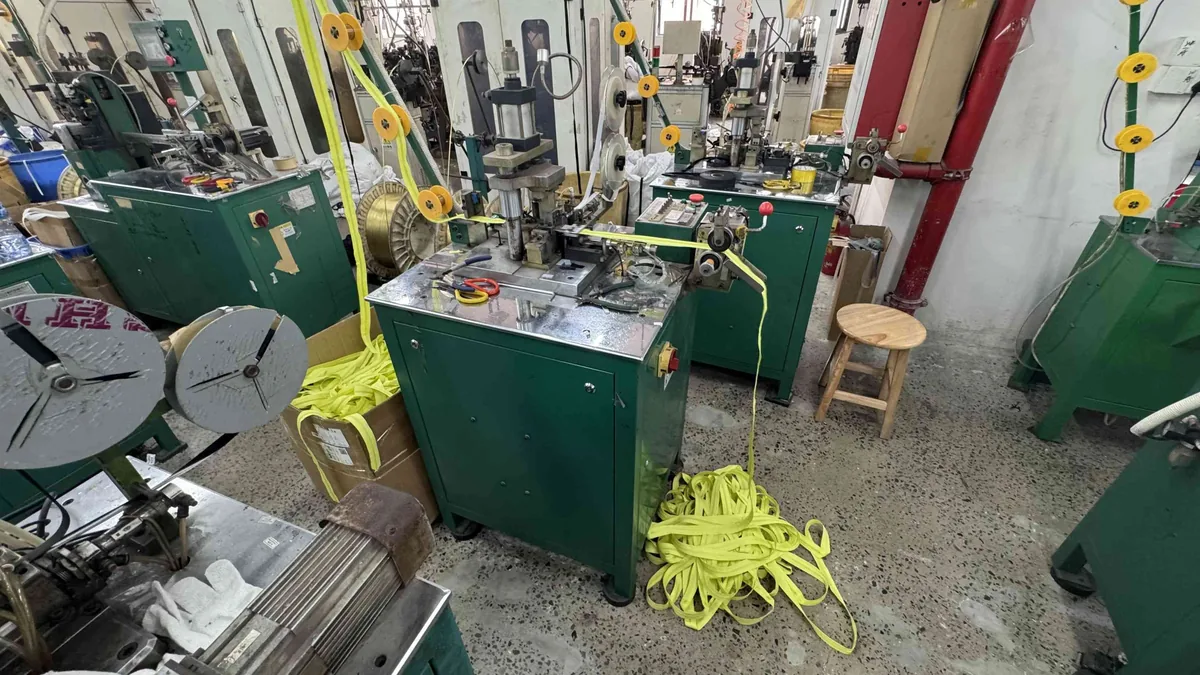
Continuous zipper chain is the two tapes and interlocking elements supplied as an uncut length, commonly on a roll. It is not automatically a complete closure. Depending on the order, sliders, pullers and stops may be supplied separately, so the receiving factory needs the correct equipment and work instructions to turn the chain into usable pieces.
This format can suit production that uses one chain family and color across many lengths. A bag maker, for example, may cut short pocket openings and longer main openings from the same approved chain. It can also reduce the number of finished-length variants held in stock.
Do not assume “roll” defines everything. The RFQ must still state chain type, nominal size, tape color, quantity or roll length, slider model and quantity, puller, end-finishing method and application. Review the parts of a zipper if your team needs a shared component vocabulary.
2. What is a finished zipper?
A finished zipper is cut to the ordered functional length and assembled with the specified slider arrangement and end components. It may be closed-end, one-way open-end or two-way open-end. Those constructions are different products, not merely different cuts of the same roll.
Finished units are useful when the garment or product factory does not install sliders and stops, when lengths are stable, or when the buyer wants one approved assembly to arrive ready for sewing. They also make unit counting and length-based incoming inspection more direct.
For a separating jacket front, a finished open-end zipper is usually the practical choice because the box, pin, slider orientation and functional length must work together. Use the open-end vs closed-end guide to define that construction.
3. Choose by production workflow
Ask these questions before choosing the format:
- Who owns final zipper assembly? Confirm whether the sewing factory can fit the correct sliders and make repeatable end stops.
- How many finished lengths are required? Continuous chain can simplify inventory when many lengths share the same chain, tape color and slider system.
- Must the product separate completely? Open-end constructions normally need purpose-built finished components rather than a simple chain cut.
- Where will length be controlled? Name the station, measuring method and tolerance agreed for the project.
- Who inspects the final closure? The party completing the zipper must check slider direction, stops, chain engagement and finished length.
If these responsibilities are unclear, finished zippers usually remove more ambiguity. Continuous chain only creates flexibility when the receiving factory has a controlled conversion process.
4. Cost comparison: evaluate total conversion cost
Do not compare only a roll price with a finished-piece price. A useful comparison includes:
- chain, sliders, pullers and stops;
- cutting and slider-fitting labor;
- equipment, setup and operator training;
- scrap at changeovers and unusable remnants;
- rework from reversed sliders, weak stops or wrong lengths;
- inspection, counting, packing and inventory complexity.
Continuous chain may reduce finished-length inventory, but it also moves labor and quality risk downstream. Finished zippers include more supplier assembly, but they can reduce operations at the sewing line. Request both quotations against the same approved chain, components and annual length mix, then compare total landed and conversion cost. Prices, MOQ and lead time must be confirmed for the actual inquiry; see the custom zipper MOQ, sampling and lead-time guide.
5. Specification checklist for each format
| Specify for both | Add for continuous chain | Add for finished zippers |
|---|---|---|
| Chain type and nominal size | Roll length or total length | Finished functional length by SKU |
| Tape color and element color/finish | Slider quantity and fitting orientation | Closed, one-way open or two-way open end |
| Application and fabric construction | Stops or termination method | Slider count, orientation and meeting position |
| Puller style and finish | Cutting and assembly responsibility | Top/bottom component configuration |
| Quantity and required tests | Packing of chain and loose components | Piece counting and bundle identification |
For a complete purchasing record, combine this table with the zipper specification sheet. If chain type is not yet settled, compare nylon, metal, resin, invisible and waterproof zippers.
6. Sample and quality approval
Approve the format that production will actually receive. For continuous chain, do not approve the roll alone: cut representative lengths, fit the intended sliders and stops, sew them into a representative product, and inspect the completed closures. For finished zippers, approve each critical length and end construction rather than assuming one size covers all variants.
Record at least:
- approved chain, tape color and element finish;
- compatible slider and puller, including direction;
- finished length measurement method;
- top and bottom termination;
- smooth operation through the full opening;
- appearance after sewing and any agreed care or performance checks;
- traceable sample or approval reference.
The zipper quality inspection checklist and quality-control overview provide a framework. Project-specific test methods, sample quantities, tolerances and pass criteria should be agreed before production.
7. Copy-and-use RFQ template
Delivery format: [continuous chain / finished zippers / please advise]
Application and product construction: []
Zipper type and nominal size: []
Tape color and teeth/coil finish: []
Continuous chain total or roll length: []
Finished lengths and quantity by length: []
End construction or downstream termination: []
Slider quantity, type and orientation: []
Puller design, finish and logo: []
Who cuts, fits sliders and installs stops: []
Packing and identification: []
Required sample, inspection and tests: [___]
Drawing, product photo or reference sample: [attached]
Common ordering mistakes
- Treating a roll of chain as a ready-to-sew zipper.
- Ordering chain and sliders without confirming compatibility and orientation.
- Choosing continuous chain for an open-end garment without defining the box-and-pin assembly.
- Comparing unit prices while ignoring cutting, fitting, waste and inspection.
- Failing to state who controls finished length and installs end stops.
- Approving raw chain but never testing a converted, sewn sample.
Frequently asked questions
Is continuous zipper chain a complete zipper?
Not by itself. It is the continuous chain assembly; the production plan must define sliders, pullers, cutting and end terminations before it becomes a functional finished closure.
When should a bag factory order zipper chain by the roll?
It can be suitable when the factory uses the same approved chain across multiple closed-end lengths and has controlled equipment and instructions for cutting, slider fitting and stops.
Can continuous chain be used for open-end jacket zippers?
Do not assume so. A separating zipper needs a compatible box, pin, slider arrangement and controlled assembly. Finished open-end units are normally the clearer purchasing format unless the receiving factory has an approved assembly process.
Are sliders included with continuous zipper rolls?
Inclusion varies by quotation. State the slider type, quantity, orientation, puller and packing explicitly; never infer them from the word “roll.”
How should finished zipper length be specified?
State the end construction and functional measuring points, not only a number. The correct method differs between closed-end and open-end zippers; confirm it with the approved sample.
Which format has the lower cost?
It depends on the full workflow. Compare components, conversion labor, equipment, scrap, rework, inspection, packing and inventory—not only the supplier’s unit or roll price.
Final recommendation
Choose continuous chain only when flexibility in cutting is valuable and the receiving factory can reliably complete and inspect the zipper. Choose finished zippers when you need exact, repeatable, ready-to-sew units or separating end constructions. In either case, approve the complete closure in the real product—not just the chain.
For a format review or quotation, contact CEO Zipper and send your length mix, application and sample photos to Gary Dong at [email protected] or WhatsApp +86 135 0962 3269.